
Balance Definition: Meaning, Examples, Uses & Easy Explanation
Achieving balance in our lives is often seen as a luxury, yet it’s a crucial ingredient for success and happiness. In this article, we’ll dive into the balance definition, exploring its meaning, practical uses, and real-world examples.
Understanding the definition of balance can empower you to create a more harmonious life, both personally and professionally. By the end, you’ll have a clearer sense of what balance truly means, and actionable insights to implement in your daily routine.
Balance Definition
Balance meaning refers to a state where different elements are in harmony, ensuring that no part is too heavy or overwhelming. In a broader sense, it means maintaining proportion and stability in various aspects of life, such as work and personal time.
TL;DR
- It refers to steadiness, fairness, or equilibrium.
- It acts as both a noun (e.g., a balance in life) and a verb (e.g., to balance tasks).
- It often indicates remaining money (e.g., account balance).
- It is commonly contrasted with “imbalance,” highlighting unevenness or unfairness.
- It always consider the surrounding context for accurate interpretation.
What Balance Means in Plain English
Balance refers to a state of stability or harmony. It applies to various aspects like the body, finances, emotions, ideas, design, or time management.

At its core, balance is about maintaining equal weights or control over different sides.
Examples:
- She maintained her footing on the slippery pavement.
- The dish had a great mix of sweet and spicy flavors.
- I need to find a better mix of work and relaxation.
Part of Speech: Is Balance a Noun or a Verb?
Balance can be both a noun and a verb, with its meaning depending on how it’s used in a sentence.
As a noun, “balance” refers to a state, amount, or concept. For example: “Her balance on the tightrope was impressive,” or “Make sure to check your bank balance.”
As a verb, “balance” indicates an action. For instance: “He needs to balance his work and personal life,” or “Can you balance that stack of books?”
The adjective “balanced” describes something as steady or fair, like in “She provided a balanced perspective during the discussion.”
Pronunciation of Balance
The pronunciation of “balance” is BAL-uhns in American English, with two syllables. To say it correctly, remember:
- BAL rhymes with “pal.”
- uhns is a soft sound, like “uhns.”
- The stress is on the first syllable, so it should sound like BAL-uhns.
A common mistake is saying “bay-lance.” Instead, think of short sounds like in bat or bag. For example, you could use “balance” in sentences like, “I need to find the right balance in my work-life,” or “The balance on the scale is perfect.”
Main Uses of Balance
Balance is a term with several important meanings, depending on the context.
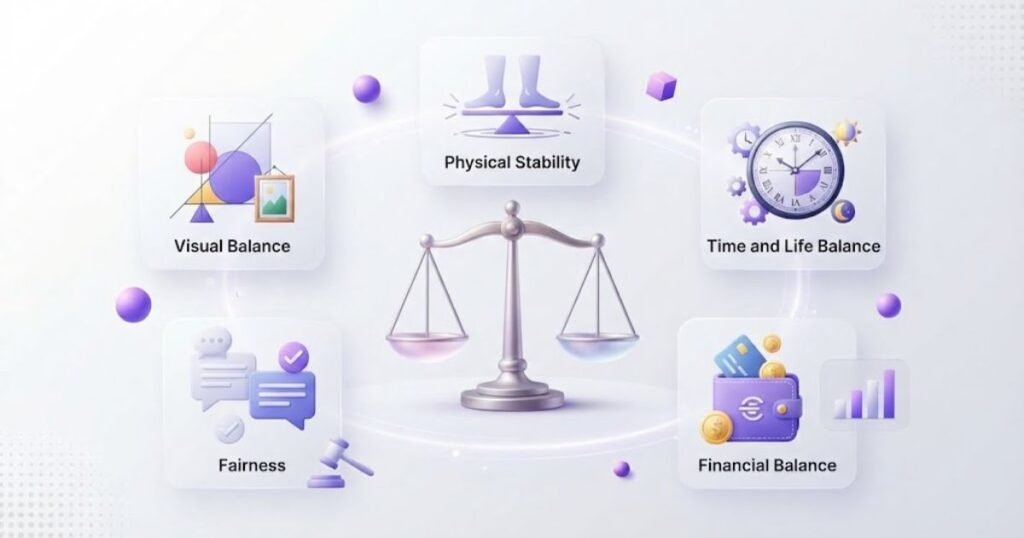
| Context | Best Choice | Why |
| Body movement | keep your balance | Means stay steady |
| Time or life | find balance | Means manage parts well |
| Money | account balance | Means money left or owed |
| Fairness | provide balance | Means show more than one side |
| Design or art | visual balance | Means parts feel even |
- In physical contexts, like when a skater loses her balance, it refers to maintaining stability.
- In life, balance often relates to time management and ensuring that one aspect, like work, doesn’t overshadow others, such as family. Striking a healthy balance is crucial for overall well-being.
- When discussing finances, balance typically refers to the amount of money that is either available or owed, like your bank balance.
- In terms of fairness, balance signifies giving equal attention to different sides of an issue, ensuring that no part is overlooked.
- In essence, balance is about finding a harmonious middle ground in various aspects of life.
How to Use Balance in Sentences
Using balance in sentences is all about creating harmony between different parts of your message. This often involves verbs and nouns that reflect steadiness or equality. For example, you might say, “I try to balance my studies with a part-time job,” which shows how you maintain control over both commitments.
Other way to express balance is by comparing two elements. Phrases like “balance A against B” or “balance facts with context” help clarify how different ideas relate to each other. For instance, “The coach balanced hard workouts with rest days” illustrates the importance of both effort and recovery in training.
Balance is key whenever two or more elements need to be managed wisely. So next time you write, think about how you can maintain that important sense of balance in your sentences.
Common Phrases with Balance
Here are some common phrases with “balance” that are easy to understand:
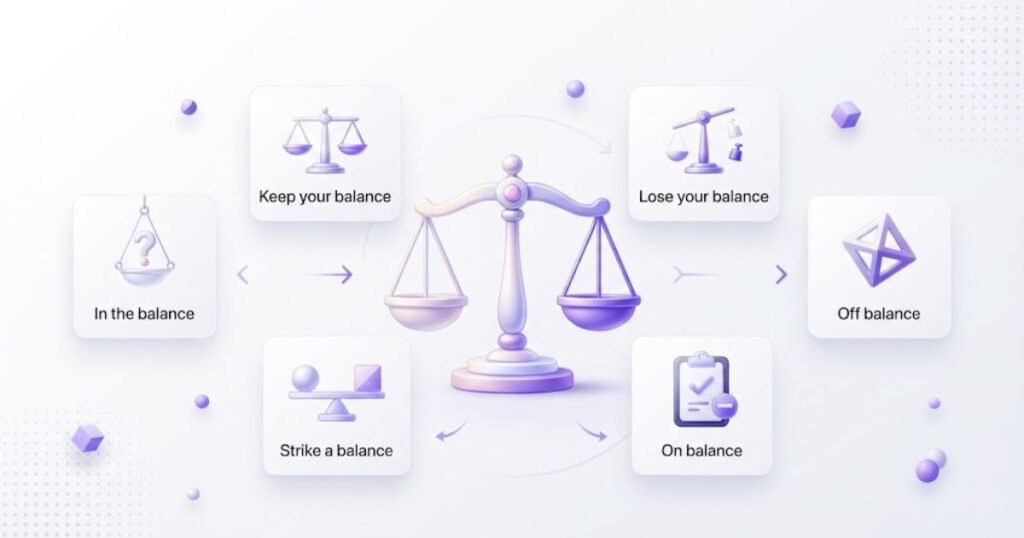
1. Keep your balance means to stay steady. For example, when walking on a narrow ledge, it’s important to *hold the rail to keep your balance*.
2. Lose your balance refers to the moment when you start to fall or lose control. For instance, if you step on a wet floor, you might say, *I lost my balance*.
3. Strike a balance is used when you need to find a good middle ground. For example, in a project, you might need to *strike a balance between cost and quality*.
4. On balance means considering all factors before coming to a conclusion. You could say, *On balance, the plan seems fair* after weighing the pros and cons.
5. In the balance indicates that the outcome is still uncertain. You might say, *The final decision hangs in the balance* until all options are considered.
6. Off balance can describe both physical and emotional instability. For example, *The sudden news threw me off balance*, making it hard to react calmly.
Read More: GTFO Meaning in Text: Chat, Slang & Uses (2026)
Synonyms and Antonyms of Balance
Balance can have different meanings, so its synonyms vary based on context. For example, if you’re talking about a stable situation, you might use stability. In discussions about ideas or designs, harmony fits well.
If you’re looking for fairness in reports or opinions, then fairness is a great choice. Each word offers a more precise way to convey your message.
Common antonyms for balance include imbalance, which describes an uneven state, and instability, indicating a lack of steadiness. If there’s inequality in treatment, that also opposes the concept of balance. So, knowing the right terminology can really enhance your writing!
Example:
- Correct: The report needs balance.
- Better synonym: The report needs fairness.
- Antonym: There is an imbalance in the statistics.
Common Mistakes with Balance
Here are some common mistakes people make with the word “balance”:
1. Using Wrong Context:
- Mistake: “I checked my body balance at the bank.”
- Correction: “I checked my account balance at the bank.”
- Mistake: “She balanced very fairness.”
- Correction: “She gave a balanced and fair answer.”
2. Confusing Meanings:
- Mistake: “This is balance slang for cash.”
- Correction: “Balance usually means money left or owed.”
3. Balance vs. Balanced:
- Use “balance” as a noun or verb (e.g., “The meal has balance”).
- Use “balanced” as an adjective (e.g., “The meal is balanced”).
Learn More: What Does Ion Mean In Texting And Online Chat? 2026
Conclusion
The balance definition provides valuable insights into maintaining harmony and stability in different aspects of life. By exploring the definition of balance, we uncover its significance in promoting health, productivity, and satisfaction. The balance meaning serves as a reminder that life is about finding the right proportion of various elements.
As you apply these principles, you’ll see improvements in how you manage your time, resources, and relationships. Start implementing these strategies for a more balanced life and experience the positive changes firsthand.
FAQs
What is the Synonym of Balance?
The synonyms for “balance” include equilibrium, stability, and poise. Each word captures a sense of maintaining a steady or even state in various contexts.
What is The Meaning of Balance in Money?
Balance definition in money refers to the amount of money you have in your account after all transactions, like deposits and withdrawals, are taken into account. It shows your net available funds or the total debt you owe if it’s a loan account.
What is The Full Meaning of Balance?
Balance refers to an even distribution of weight or elements that fosters stability and harmony. It’s essential in various aspects of life, from physical stability to emotional well-being.